Concert Technologies Logo Accelerating the Speed of Technology Rollouts

Contact Us

 
Home The Concert Difference Services Markets White Papers & Resources About Us
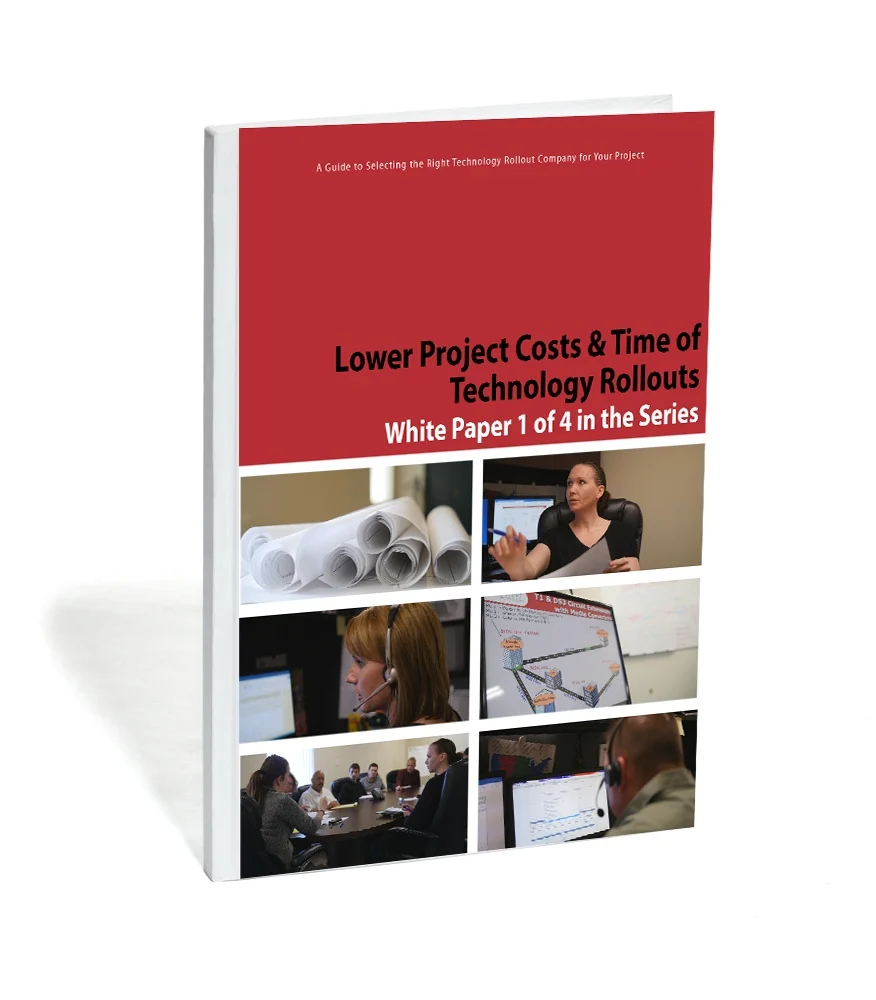
White Paper
 

1st in the Series "A Guide to Selecting the Right Technology Rollout Company for Your Project"

Lower Project Costs & Time of Technology Rollouts

A Concert Technologies White Paper

PDF Version

Return to White Paper Library


Table of Contents

Executive Summary
Introduction
Defining the Relationship of Technology - Solution - System
What is a Technology Rollout?
Defining a Technology Rollout System
The Role of the Web-based Software Application
System Part 1: Process Structure
System Part 2: The Rollout Services Model
System Part 3: Internal Resources
System Part 4: Partnerships
Expertise Matters
How the Ideal System Benefits Your Project
What You Should Know Before Making a Decision
Conclusion
About Concert Technologies
References
Diagrams

Executive Summary

This paper explains a Technology Rollout System, how it lowers costs and saves time without compromising quality, and provides essential questions to ask any technology rollout company.

Suppose you have a legacy enterprise network that connects many offices nationwide or globally and you want to install new, standardized circuits and equipment in all of them. You can't rely on a technology rollout company that only offers a single point of contact, Web-based management software, and local contacts. The project rollout is simply too complex and the snafu potential too high. Success requires a proven network of processes and services that work together smoothly and effectively. It also requires a company with in-depth, industry-wide expertise. A Technology Rollout System embodies these critical qualities. Without a proven Technology Rollout System, you run a high risk of project complications that result in increased costs, missed deadlines, and an overwhelming burden on internal resources.

What Is the Ideal Technology Rollout System?

The ideal Technology Rollout System enables rapid rollouts of multi-technology, multi-service, multi-site on a nationwide and global scale. It has four key parts:

  • Centralized Single-Tier Structure. The company manages field technicians directly.
  • Proven, Universal Model. The model has a history of success and works across individual rollout technologies.
  • Internal Resources. The company has deep expertise, experience and infrastructure.
  • Broad Network of Partnerships. The company has technicians near every site to work swiftly and efficiently and minimize the risk of no-shows and inexperienced technicians.

What Are the Benefits of the Ideal Unified Technology Rollout System?

An experienced company implementing the ideal Technology Rollout System can achieve rollouts across the broadest geographies with speed, efficiency, and quality. Among its key advantages:

  • Saves project costs
  • Saves time
  • Cuts project management requirements for the customer
  • Scalable
  • Flexible
  • Independent of equipment and technology
  • Yields higher quality of service

Technology Rollout System

Top

Introduction

"To succeed on the implementation journey, your roadmap and plan need to be realistic, achievable and grounded in practical experience."

- Isabel Wells, CIO Update

The rapid deployment of multi-technology, multi-service, multi-site field rollouts requires well-defined processes, robust management skills, and a unique understanding of how to get the job done. This paper will assist in understanding the many variables and establish what the customer should expect from a technology rollout company providing nationwide and global services. It will explore the ideal unified Technology Rollout System and bring to light the issues that can only be resolved by employing a multi-dimensional system for complex nationwide and global technology rollouts. Due to the complexity of technology rollouts, this will be the first in a series of topics that will each address a critical aspect of nationwide and global rollout services.

How This Information Benefits You

  • Minimize project costs and time by understanding how a Technology Rollout System is applied on a nationwide or global
    level and how it can affect your budget, service, and selection process.
  • Establish an accurate view of project expectations including costs and time by learning how to categorize your rollout.
  • Decide the right system for your rollout by understanding how to identify and evaluate a technology rollout company's system capabilities.
  • Improve customer satisfaction by executing a project from start to finish with a proven, efficient Technology Rollout System.

Defining the Relationship of Technology - Solution - System

Implementing nationwide and global technology rollouts requires the in-depth knowledge and expertise of an experienced technology rollout company. Today, technology rollout companies commonly provide the same elevator sales pitch that touts a single point of contact, field resources across multiple locations, and a Web-based software application to manage projects.

However, in successful rapid nationwide and global technology rollouts, there is a distinct difference between these one-dimensional "systems" and companies that employ a defined Technology Rollout System that is capable of meeting aggressive goals. But first, it is important to understand how the System fits into the technology and solution relationship.

The relationship between technology, solutions, and a system is often confusing due to the lack of defined areas of responsibility. From a nationwide and global deployment perspective, this relationship is defined in the following way:

Technology Solution System Relationship

  1. Technology is the driving force for the Solution. It can be comprised of various new or legacy equipment and sets the stage for what type of Solution will be designed.

  2. The Solution answers the technology requirements. It defines the project requirements and sets the stage for the implementation phase - the System.

  3. The System is the processes, services, resources, and relationships required to implement the Solution. It provides the map to deliver the Solution to every site with speed and highest quality of service.

The rollout services industry typically wraps "system" (implementation phase) into the Solution definition. However, we believe the System's implementation of the Solution is of critical importance and has its own key role in the overall project. If the proper System is not in place to deliver the technology rollout services, fluidity and efficiency will be lacking.

The System/implementation phase is the area providing the potential for gains in rollout speed and quality, and so deserves special attention.

Top

What is a Technology Rollout?

Terms:

Technology Rollout
Consists of (a) multiple sites (b) requiring technology services (c) implemented by onsite field technicians.

Customer
The organization or individual that engages the technology rollout company.

Technology Rollout Categories

By understanding rollout categories and their specific requirements, the customer will be better able to explain the level of service required to the technology rollout company. The three technology rollout categories are outlined below, numbered in
order of duration and relevance to nationwide or global rollout services.

Note that a single project can consist of multiple categories. Example: Total project scope consists of 350 Category 1 rollout sites, 5 Category 2 rollout sites, and 1 Category 3 rollout site.

Technology Rollout Categories

Defining a Technology Rollout System

Today's Technology Rollout System is a comprehensive, multi-technology, multi-service, multi-site system designed to meet varying project requirements in an ever-changing telecommunications industry. It is comprised of four parts: Process Structure, Rollout Services Model, Internal Resources, and Partnerships.

Technology Rollout System

  • Process Structure: A Technology Rollout System is supported by the Process Structure. This structure defines the processes for management of each technology rollout via Internal Resources and Partnerships. This includes the Software Application that provides web-based services for customer projects.

  • Rollout Services Model: The Rollout Services Model is comprised of integrated multi-service components that are implemented through the Process Structure. It is designed to meet and exceed the reliability and flexibility needs of today's rollout requirements.

  • Internal Resources: The internal resources support a Technology Rollout System and include the internal operations, network infrastructure, system applications, training, and company culture necessary to complete multi-technology, multi-service, multi-site field rollouts on time and within budget.

  • Partnerships: Partner relationships are a critical piece of a Technology Rollout System. With multiple local resources located nationwide or globally, a Technology Rollout System ensures that all site locations are serviced in a timely and efficient manner. When employed by a capable rollout company, this integrated System enables the company to manage all implementation services at peak efficiency, which translates to lower costs and time while providing high levels of service.

The Role of the Web-based Software Application

Web-based Software Applications are proficient at capturing processes, documenting work, and providing visibility into projects. But a true Technology Rollout System should consist of more than just a Software Application. It should be well defined and capable of efficiently leveraging all available resources to provide benefits such as project flexibility. A single Web-based Software Application falls short in this regard.

Example Scenario: If a customer averages 300 technology rollouts per week (Category 1), how does the technology rollout company accommodate an increased scale of 600 rollouts per week without decreasing quality of service?

Answer: The rollout company relies on its Internal Resources and Partnerships that support its defined Process Structure in order to escalate capabilities. With its primary purpose to provide easily accessed services for customers (such as reporting and project documentation), a Web- based Software Application cannot account for changes in project scope, scale, or address advanced customer needs. It serves as a support tool, not as a viable replacement for the System itself.

A Web-based Software Application alone will not suffice as the company's sole 'system' of providing rollout services. Thus the need for a well-defined, proven Technology Rollout System, which includes a Software Application as part of its process structure, capable of the growth and expansion required to meet the ever-changing needs of today's technology rollouts.

System Part 1
Process Structure

The rapid deployment of multi-technology, multi-service, multi-site field rollouts across nationwide and global environments requires a defined Process Structure as well as a unique understanding of how to get the job done. Various Process Structures are employed by technology rollout companies to facilitate the management of multi-site nationwide and global projects. The primary Process Structures and their advantages are explained below. Refer to the Process Structure diagrams for additional information.

Top

What are the Process Structures?

  1. Centralized Single-Tier (see diagram)
    The customer uses a technology rollout company that directly manages field technicians through a direct partnership.

  2. Centralized Multi-Tier (see diagram)
    The customer uses a technology rollout company that hires subcontractors in a tiered hierarchy to manage field technicians.

  3. Rent-a-Tech (see diagram)
    The customer or technology rollout company uses a Rent-a-Tech company in a shared management effort of field technicians.

  4. Internal Employee (see diagram)
    The customer or technology rollout company uses internal employees for project management and field technicians. In Internal Employee Process Structures, additional external local field technicians are likely to be required due to the number of sites and costs associated with employing sufficient internal field technicians to handle nationwide or global rollouts.

  5. Additional Structures: Hybrid (see diagram)
    A number of variations of the four basic structures may exist as a hybrid structure. They will have associated advantages and disadvantages on an individual structure basis.

Single Point of Contact vs. Multi-Point of Contact

The meaning of Single Point of Contact may vary within a given process structure. It can be used in a misleading manner to describe the interaction between the customer and multiple individuals within a single company. This is accurately described as Multi-Point of Contact within a single environment. True Single Point of Contact communications means a single individual with which the customer interacts. However, it is critical that the single point of contact is not the customer's only point of contact. Examples: Escalation Needs or Employee Absence.

Comparison Scenario: Process Structures in Action

The following information compares the pros and cons of each of the primary Process Structures.


Comparison Scenario Summary

Based on the comparisons above, the Centralized Single-Tier Process Structure provides superior benefits and highest quality of service when employed as part of a Technology Rollout System.

Ideal Process Structure: Centralized Single-Tier

Key Benefits

  • Defined project implementation responsibility by technology rollout company
  • Minimized project costs
  • Highest quality of service
  • Technician redundancy that ensures project completion
  • Timely and accurate communication
  • Project tracking accountability and growth capabilities
  • Highest quality of technicians

Top

System Part 2
The Rollout Services Model

Traditional service models are dependent on individual technology and equipment services. However, to maximize efficiency and speed of large-scale rollouts, technology rollout companies should have a proven Rollout Services Model that is technology independent and universally adaptable. Such a Rollout Services Model enables rapid, nationwide rollout services that include the planning, management, and implementation of all necessary activities and processes. It allows for the use of one model with a single set of processes for the entire project.

Model Components

The Rollout Services Model is comprised of nine components, which are integrated by the Project Management component. The Equipment & Technology component determines the details and requirements for the methodology and additional model components needed for a particular rollout. The components are:

1. Project Management
In order to deliver technology rollouts rapidly with a single point of contact, experienced project management is crucial. The ideal Project Management component incorporates three primary roles:

  • Program Manager: This position oversees all programs, project managers, and provides quality assurance.

  • Project Manager: This is the customer's single point of contact from the initial meeting through the completion of the project.

  • Project Facilitator: The Project Facilitator is fully responsible for all aspects of day-to-day delivery of rollout services including scheduling and coordination of all local and internal resources.

  • Warehouse Manager: This positions supervises equipment deployment & logistics.

  • Technology Manager: The Technology Manager manages the Web-based Software Application and provides support functions.

  • Partnership Manager: This role manages the recruitment and quality of the technology rollout company's partnerships.

Additional project management services can be incorporated into individual components (i.e., Warehouse Management, Billing Management).

Project Tracking: Under the Project Management component, real-time project status and updates are provided via an interactive Web-based portal that allows the customer to create online orders, view site history, and track the project.

Master Rollout Analysis
Every component in the Rollout Services Model has an individual set of processes. Each of these processes are detailed in a Component Template. Templates can be combined to customize the services required for each unique rollout project.

  • Component Templates: Each component has pre-defined templates that work in conjunction with one another to provide modularity. This enables the rollout company, during the analysis phase, to propose specific project requirements and necessary services in a relatively short time.

  • The proposed Component Templates and pricing are incorporated into a Master Rollout Analysis that determines all project requirements. The analysis also evaluates the project for any change management that must occur before the rollout processes begin and defines the post- rollout matrix needed to gauge performance.

2. Circuits
Connecting a business's network to the rest of the world, the circuit is crucial to business operations. Accordingly, a technology rollout company should be fully experienced with circuit installation and testing. Additionally, the company should have established relationships with carriers and ILECs in order to accelerate circuit delivery.

3. Equipment & Technology
While many traditional technology rollout companies specialize in specific equipment, the Rollout Services Model is universal. It can be applied to all voice, video, security and data equipment/ technology. Thus, a company employing the Rollout Services Model is not limited. It can provide services such as installations, configuration, decommissioning, maintenance, and servicing for any type of equipment and technology.

4. Cabling
Cabling adds complexity to rollouts. Whether the need is for cabling inside or outside the plant, or cabling through limited pathways, a technology rollout company should offer full services that can meet any need including moves, adds, changes, testing, cable management and electrical cabling when required.

5. Site Surveys & Estimates
In order to estimate project requirements accurately, site surveys are essential in determining job scope and equipment. There are two types of surveys, phone and onsite, used to determine the requirements for each site.

6. Logistics & Configuration and Asset Management
Robust Logistics & Configuration and Asset Management capabilities enable technology rollout companies to meet rapid rollout schedules and Service Level Agreements (SLA). Companies must have a sufficient number of nationwide equipment depots in order to provide the equipment and materials onsite within established timeframes. Additionally, they should have experience in the areas of inventory management, staging, equipment configuration, testing, kitting, rack/stack, return services, logistics and purchasing.

7. 24/7 Maintenance
A technology rollout company must be able to provide 24-hour support - anytime, anywhere. Capabilities should include response speed and accuracy combined with service experience that includes: immediate issue ticketing, site history and circuit/equipment ID checks, real-time email and website status alerts, dispatching of certified local technicians, and nationwide equipment distribution.

8. Billing
A project with multiple technicians working across multiple site locations generates multiple bills.
With the Rollout Services Model, the technology rollout company provides a single consolidated bill
delivered within days of job completion in the customer's chosen format.

9. Solution Support
The Solution Support Component is an integral part of the relationship between the Solution and a Technology Rollout System which implements that solution. Individual services in this component can be broad and varied, but always include support elements for the customer that add the value of the technology rollout company's expertise and flexibility to the solution being implemented.

NOTE: Depending on the project needs, not all components may be required. However, having each components available as service options ensures that the rollout company can meet all potential project capabilities at the best balance of quality service and minimized cost.

System Part 3
Internal Resources

"The ability to elicit tacit knowledge, and to collaborate across cultures and distances and multiple agendas, requires a technical infrastructure that can seamlessly handle structured and unstructured information, text, images, audio, video, and all sensory data."

- C.K. Prahalad & Venkatram Ramaswamy, Optimize

A rollout company's Internal Resources work hand-in-hand with its nationwide and global field partnerships. Internal Resources should include:

  • Internal operations
  • Network infrastructure
  • Software applications
  • Training
  • Company culture
  • Additional elements

For companies that provide a single point of contact, a full set of internal resources provides customers with complete communications redundancy through the rollout cycle as well as the ability to meet initial project time and cost estimates when additional project needs arise.

System Part 4
Partnerships

Field Partnerships are, of course, key to implementing multi-technology, multi-service, multi-site nationwide and global field rollouts. In the Technology Rollout System:

  • Partnership management is based on the process structure collaboration tools in place. With the Centralized Single-Tier Process Structure, all local field force management is handled by the technology rollout company.

  • Partner relationships ensure that there are field technicians within close proximity to all site locations, whether they are nationwide or global, for every rollout project. This means that all sites are serviced quickly and efficiently.

  • Partnerships allow for technician redundancy and minimize any risk of project time or cost increase due to technician no-shows - additional partners are available as needed.

Expertise Matters

"Three things are essential to driving strategic innovation. The first is making the right strategic choices. The second is about having a grip on what the innovative capabilities required for success look like. And the third is about somebody being capable of assuming the leadership role, and driving the execution."

- William A. Fischer, IMD

An instrument is only as good as the musician who plays it. The same is true of a Technology Rollout System and the company that employs it. Without the experience that comes from successfully completing thousands of nationwide and global rollout projects, the company will not have the ability to leverage the System's capabilities. Rapid deployment experience and expertise is an essential piece of implementing a Technology Rollout System and delivering the related benefits to its customers.

  • Proven experience
    A time-tested System together with an experienced company provides a great benchmark for customers as they evaluate potential vendors. A company should have completed thousands of projects across multiple environments to ensure the necessary expertise to deliver projects on time and within budget.

  • Project deployment volume
    In addition to evaluating experience and expertise, customers should assess the number of weekly projects completed. This number will serve as a valid indicator that they use a proven, effective Technology Rollout System capable of completing large-scale, high-volume projects and have the resources to accommodate increased project growth.

  • Industry knowledge
    Knowledge of the industry in which the technology rollout company operates is another critical factor in providing rapid nationwide and global rollout services. Knowledge of solution providers' project requirements plus an understanding of circuits and networks provide additional evidence of the company's capabilities.

  • Financial strength and partnership wisdom
    Understanding a technology rollout company's financial strength and partnership relationships further aids a customer's selection process. Managing dozens to hundreds of local partners daily demonstrates advanced skills. The company should be experienced in the resolution of payment and job-related disputes as well as possess the financial responsibility to process timely payments to its partners.

How the Ideal System Benefits Your Project

"It's about marrying efficiency with innovation and requiring managers to consider the following: cycle time and cost reduction, leveraging scale and scope, reduction of resources, partners as role models for change, and reduction of risk."

- C.K. Prahalad & Venkatram Ramaswamy, Optimize

The ideal Technology Rollout System discussed at length in this paper defines a unique industry service standard that sets companies that employ it apart from traditional, one-dimensional, technology-dependent service companies. It is detailed in the following diagram.

The list below summarizes the primary benefits of the ideal Technology Rollout System.

  • Minimized project costs and time.
  • Multiple services in fewer truck rolls.
  • Technician redundancy and proximity to nationwide and global site locations.
  • Rapid delivery times ensure project completion deadlines and emergency response requirements are met.
  • Reduced customer project management responsibilities allow customers to focus on what's important to them - their business.
  • Scalable and flexible to meet increasing industry and customer project demands.
  • Equipment and technology independence ensures implementation of any solution (new or legacy) rapidly and efficiently.
  • Higher level of quality of service due to well- defined processes, procedures and methods.
  • Reduced risk of project complications by working with a company that uses a proven system.


Ideal Technology Rollout System

What You Should Know Before Making a Decision

Assessing the capabilities of a technology rollout company is vital before awarding a nationwide or global project. Before making a decision on which technology rollout company to use for your critical project implementation needs, first find out does the company:

  • Employ a comprehensive Technology Rollout System with defined Process Structure, Rollout Services Model, Internal Resources, and Partnerships?

  • Utilize a particular type of Process Structure?

  • If it is Centralized Single-Tier, does the company manage field technicians directly? (If not, then it is not a true Single-Tiered Process Structure.)

  • If it is not Centralized Single-Tier, how will the company compensate for missing benefits, lower quality of service, and/or higher price?

  • Have a verifiable level of expertise (years of operation, weekly project load, etc.) in rapidly deploying nationwide or global technology rollouts?

  • Offer true single-point-of-contact communication or is it multi-point communication within a single environment?

  • Have a record of establishing strong partnerships? (Having partnerships at every available geographic location helps minimize travel and response time, thus lowering costs.)

Additional in-depth information about evaluating technology rollout companies effectively will be provided in upcoming issues within this series.

Conclusion

Customers can employ rapid, cost-effective, "hands-free" solutions for their large, complex technology rollouts. However in order to do so, they must realize that the rollout company they choose has to offer more than just a single point of contact utilizing a software tracking system and contacts in various locations.

Tangible benefits come from experienced, expert rollout companies that offer a proven system of processes and services that work in harmony to achieve the desired results. The ideal Technology Rollout System enables companies to minimize project costs, ensure timely project completion, and reduce customer management effort.

About Concert Technologies

This paper was authored by Dennis Mazaris, President and Founder of Concert Technologies. Since 1995, Concert Technologies has offered rapid delivery of multi-technology, multi-service, multi-site rollouts on both a national and global scale. Our Maestro Technology Rollout System®, the world's first unified system, is based on the proven methodologies that span our extensive experience of providing professional rollout services.

For more information:

References

Fischer, William A., Innovation: The Critical Path to Success or Failure, Keeping up with the pace of change, IMD, (April 2008).

Prahalad, C.K. & Ramaswamy, Venkatram, The Collaboration Continuum Understand the Full Goals and Complexity of Collaboration Before Moving Forward, Collaborative Strategies, Optimize (November 2001).

Wells, Isabel, et al, Ten Tips for Successfully Implementing ITIL, CIO Update (October 5, 2005).

Process Structure Diagrams

Return to Process Structure Information

Process Structure Diagrams

Return to Process Structure Information

Process Structure Diagrams

Return to Process Structure Information

Top

Return to White Paper Library

Home About Us Careers Contact Us Site Map Privacy Policy
CONCERT TECHNOLOGIES, 43766 Trade Center Place, Suite 130, Dulles, Virginia 20166, Phone: 703-796-5400, Fax: 703-437-2273  |  copyright © 2010 Concert Technologies