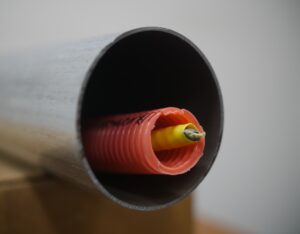
Demarc is short for Demarcation Point, or the spot in a building where telecom companies must leave their services. As mandated by federal law, all telecommunications carriers must hand off their telecom circuits to each subscriber, leaving their service at the building’s demarcation point, which is usually a ground floor telecom room. From this point, the demarc extension is the subscriber’s responsibility, extending their telecommunications circuit to their suite or network room, and begin using the telecom circuit.
Let Concert Technologies accelerate all your telecom circuit requirements through our Demarc Extension Nationwide program specifically developed to extend and test telecom circuits.
Concert Technologies presents: GSA Connections 2 Overview. GSA Connections 2 is the sister contract to GSA Networx, the Federal Government’s premier telecommunications transport contract used by agencies to deliver services to federal facilities. GSA Connections II (CNX 2) provides all federal agencies a convenient, one-stop shop for all telecommunications, networking equipment and services for your infrastructure at your building, campus and enterprise levels on a global scale. Under the GSA Connections 2 contract, federal agencies can expect a total solution, from engineering and design to support of the following technologies: riser management, enterprise networks, wireless technologies, VoIP, security devices, DAS, self serve kiosks, A/V, digital signage, building automation, energy management, structured cabling, hardware and software services, maintenance, and much more.
For more information on Concert Technologies’ Connections II contract, visit www.gsacnx2.com
Concert has the expertise to manage, install and support telecommunication circuits, Wide Area Networks (WAN), wireless technologies, VoIP, security devices such as cameras, Distributed Antennae Systems (DAS), Self Serve Kiosks, A/V such as digital signage, building automation, structured cabling, equipment configuration, field engineering, and much more through our unique methodologies.
DULLES, VA, OCTOBER 27, 2011 – Concert Technologies, the leader in nationwide technology rollouts and international technology deployments, today announced its sponsorship of the USO-Metro 8th Annual Casino Night. This charity event raises funds to support area service members and their families as well as the USO-Metro’s Hospital Services Program at Walter Reed Army Medical Center and the National Naval Hospital.
“We are happy to offer our support to such a worthy cause,” said Joshua Shaw, Vice President of Sales for Concert Technologies. “The USO Casino Night allows us to show our support for the troops and express our gratitude for the significant sacrifices they have made for our country.”
About USO-Metro Casino Night
The USO of Metropolitan Washington’s 8th Annual Casino Night will be held at the Sheraton National Hotel in Arlington, VA on October 28, 2011. Business sponsors, individual donors and honored wounded warrior guests will enjoy casino games, celebrity guests, auctions and raffles in a fun, Vegas-style atmosphere. www.usometro.org
About Concert Technologies
Concert Technologies, founded in 1995, is a privately-held technology rollout company based in Dulles, VA. It is the leader in the accelerated delivery of nationwide and global technology rollouts for government, commercial and international organizations. Utilizing our unique system of methodologies, it quickly implements, installs and manages multi-site, multi-service, technology infrastructure projects. Visit Concert Technologies online: www.concerttech.com
Filed under: Uncategorized — concerttechnologies @ 8:00 am
With summer right around the corner, many of you are gearing up for baseball season. Whether you attend one game a season, follow a team closely or even don’t normally watch baseball, you are familiar with the hand signals the players and coaches use to communicate with one another on the field. The catcher signals the pitcher, the third base coach signals the runners on the field and even the umpire signals his calls. You may not always notice the signals during the games– they are used as a transparent, behind-the-scenes form of communication that is not easily decoded by fans or members of the opposing team.
Baseball signals guide the players in the field to maximize the team’s performance and communicate plays to the members of the team. Coaches use signals to manage the team in the field during the game and alert the players to adapt to changing circumstances within the game. Watch this video of a minor league manager explaining these hand signals and how they are used for communication during a game.
A Lack of Communication = Disorganization in the System Let’s imagine two runners on the field– one on second base and one on third. Knowing the ball is in play and the conditions are not favorable for the runners to take the next base, the third base coach signals the runners to hold their positions. Without clear communication from the third base coach and the other team going for the out on second base, the second base runner could have chosen to run to third, but the third base runner may have decided to stay on third leaving one of the runners stuck in the middle. Unless the runner is able to jump and flip over the opposing team like this player, he will likely cause the team an out as well as the loss of a point he could have scored with guidance from the coach’s hand signals. This lack of communication and organization can cause the team unnecessary outs and may even lead to a loss for the team.
Technician/Technology Rollout Company Communication We all realize that hand signals and effective communication within a baseball team is crucial to their success in the game. Just like how baseball players look to designated players for signals, the field technician will look to a designated point of contact at the Technology Rollout Company for guidance and communication during a technology rollout project. With changing circumstances, like in a baseball game, the Technology Rollout Company will evaluate the most efficient methods of service and should have the processes in place to quickly communicate those changes to the technicians in the field.